Grid data · Nordic
Nordic grid’s low-inertia hours nearly quadrupled versus 2025
The rotors that keep spinning inside generators help steady the grid when a large power source suddenly disconnects. From January to 26 September 2026, the Nordic grid had far more hours with a low reading of that stored motion than in the same period of 2025. Finland’s grid operator had booked a rapid reserve for about three in four of those 2026 hours.
- 1,137hours below 150 GWs, 1 Jan–26 Sep 202617.6% of hours with complete data
- 291hours over the same dates in 20254.6%
- 75%of the 2026 low-inertia hours had FFR booked in Finland854 of 1,137
If a large generator suddenly disconnects, electricity supply drops. Inside generators still connected to the grid, heavy rotors slow slightly, releasing some of their stored motion energy. This cushions the immediate drop in the grid’s frequency—the roughly 50 Hz rhythm of alternating current—until fast reserves respond. That cushioning effect is called inertia. It comes from many machines already connected to the grid.
The Nordic grid operators estimate that stored kinetic energy every 15 minutes across Finland, Sweden, Norway and eastern Denmark. For this analysis, we counted a clock hour if at least one of its four readings fell below 150 gigawatt-seconds (GWs). Fingrid says 120–280 GWs is typical. We chose 150 GWs, near the bottom of that range, to compare the two years; Fingrid does not publish it as a rule for buying reserves. Fingrid is Finland’s transmission-grid operator. (Fingrid’s inertia explainer; kinetic-energy data)
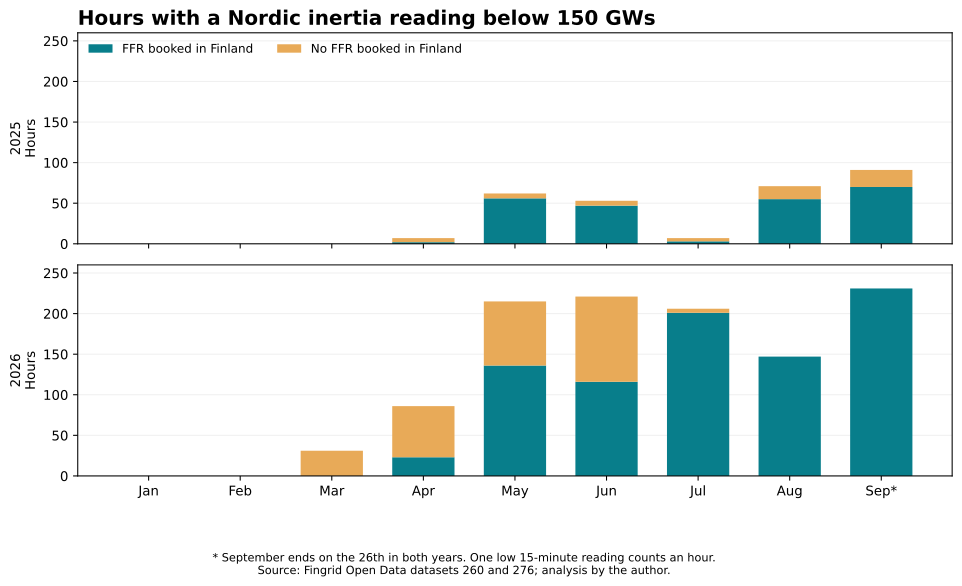
From January through 26 September 2026, Nordic inertia dipped below 150 GWs at least once in 1,137 separate hours—17.6% of the hours with complete data. Over the same dates in 2025, that happened in 291 hours (4.6%). Such dips were nearly four times as common in 2026, though these records cannot tell us why.
The first seconds after a power loss
Moving parts delay a sudden change but cannot restore balance on their own. Operators prepare a rapid response before it is needed. One such service is Fast Frequency Reserve (FFR), which can add power or cut demand in about a second during low-inertia hours. (Fingrid on reserves; FFR product information)
Too little fast reserve does not immediately cause a blackout. After a major power loss, frequency can fall without customers noticing; at 48.8 Hz, automatic protection starts disconnecting some customers to avert a wider blackout. (Fingrid’s Nordic frequency-control overview)
A 100-megawatt (MW) FFR booking sets aside that much response capacity for an hour. Fingrid pays to keep it ready; the booking is not a record of 100 megawatt-hours (MWh) of electricity delivered. Reserve units monitor grid frequency and respond automatically at their preset trigger. Fingrid’s hourly purchase data show what was reserved, but not whether it responded or by how much. (Fingrid reserve markets; FFR market information; procured-volume data)
The order of events matters. Providers submit bids the previous evening, and Fingrid confirms the next day’s hourly purchases that evening. The kinetic-energy readings in this analysis come from the following delivery hours. A low reading at, for example, 14:15 on Wednesday could coincide with capacity Fingrid had already booked on Tuesday evening. It could not have caused that earlier booking. (Fingrid reserve markets; FFR market information)
Finland’s FFR bookings during low-inertia hours
We lined up Fingrid’s Nordic inertia readings with its Finnish FFR purchases hour by hour. An hour counted only if it had all four inertia readings and a recorded FFR value, including zero. The inertia figure covers the whole Nordic grid; the purchase figure covers Finland alone. (Fingrid data on kinetic energy; FFR purchases)
| Period, 1 Jan–26 Sep | Hours with complete data | Hours with a reading below 150 GWs | Of those, hours with FFR booked |
|---|---|---|---|
| 2025 | 6,371 | 291 (4.6%) | 233 (80.1%) |
| 2026 | 6,455 | 1,137 (17.6%) | 854 (75.1%) |
Both years cover the same dates, but some hours are missing a reading, especially in 2025. We left those hours out, which is why the table has different totals for the two years.
The gap between the years opened in late spring and persisted through summer. September ends on the 26th in both years. The comparison does not identify a cause: these two series cannot tell us which generation technologies changed the Nordic grid’s inertia or support blaming batteries, wind or any other single factor.
For 283 of the 2026 hours with low Nordic readings, Fingrid’s purchase record shows no FFR booking. That was a slightly larger share than in 2025, despite far more low readings in 2026.
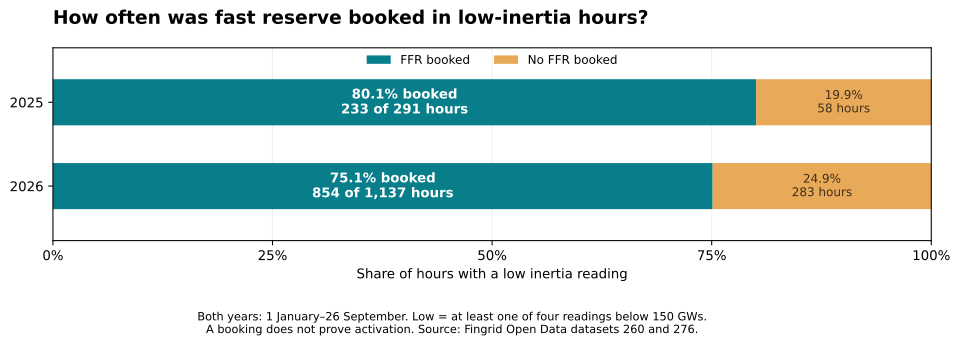
The overlap is informative, but it is not a scorecard for the operator. Fingrid bases its FFR need on forecasts of inertia and the size of the largest failure it prepares for. The purchase is made ahead of time, while our comparison uses the later, measured inertia. A coincident low reading alone should not be treated as the trigger for a purchase. (Fingrid FFR product information)
The gap survives a tougher test
The low readings were not confined to isolated quarter-hours. In 940 hours of 2026, all four readings fell below 150 GWs; the same test found 224 hours over the matching dates in 2025. Fingrid had booked FFR for most of those hours in both years.
The 150 GWs mark is useful for a consistent comparison, but a different line would produce different counts. Fingrid’s typical range of 120–280 GWs does not make either endpoint a rule for buying FFR. The available records also do not show why Nordic inertia changed between these years. Explaining that would require generation and system-operation evidence beyond these two series.
Why battery storage matters
As wind and solar displace conventional generation, fewer generator rotors may be online in some hours. Lower inertia lets frequency fall faster after a sudden power loss, increasing the need for FFR. EV charging adds demand; it does not itself lower inertia. Batteries can provide FFR if they pass the grid operator’s tests. (Nordic grid operators on wind, solar and FFR; Fingrid’s FFR requirements)
Sustainable Digital Assets Inc., issuer of SDA Token (SDA), lists battery energy storage systems (BESS) among its proposed projects. If built, qualified and selected in Fingrid’s hourly market, they would supply FFR capacity during low-inertia hours. (SDA’s proposed projects; Fingrid’s FFR market)
How we checked the data: We matched Fingrid’s Nordic kinetic-energy readings with its FFR purchases for the same hour. We counted only hours with every reading present. Some records from 2025 are stamped a minute early and overlap the regular readings, so we left them out of the main count. Using them to fill gaps barely changes the result; we have not found an explanation for the shift. The data explainer defines the table, and the Fingrid datasets named below let anyone repeat the count. Please credit Fingrid if you reuse the data or charts.
About the data
How to read the FFR comparison table
This guide explains the columns in the analysis results table. It compares Fingrid’s 15-minute Nordic inertia estimates with its hourly FFR capacity purchases. Fingrid writes gigawatt-seconds as GWs.
| Column | Meaning |
|---|---|
| Window, rule | The dates and the test for “low.” Any <150 means at least one of the hour’s four 15-minute readings was below 150 GWs. Whole <150 means all four were below it. |
| Eligible hours | Hours with all four 15-minute readings and an FFR purchase record, so the two datasets can be compared. A purchase record with a value of zero still counts as present. |
| Low hours | Eligible hours that met the row’s “low” rule. |
| Low + FFR >0 | Low hours when Fingrid had booked some FFR capacity. |
| Low + FFR =0 | Low hours when Fingrid had booked none. |
| Other hours + FFR >0 | Eligible hours that did not meet the “low” rule, but Fingrid had still booked FFR. |
For example, in the 2026 any <150 row, 1,137 hours met the low rule: 854 had FFR booked and 283 did not. The two figures add to 1,137. “Booked” means capacity was held ready; the purchase data do not show whether the reserve actually activated.
The 1 January–26 September window contains 6,456 clock hours in each year. Fingrid has an FFR record for every one. The inertia series lacks a complete set of four standard 15-minute readings in 85 hours in 2025 and one hour in 2026, leaving 6,371 and 6,455 eligible hours. Missing readings are excluded from the comparison; they are not treated as zero inertia. The method and timestamp audit explain the irregular 2025 records.
The 150 GWs line is our comparison choice, not Fingrid’s buying rule. Fingrid books FFR ahead of the hour using forecasts and other system information, so a low measured reading and a booking in the same hour do not establish cause and effect.
Summary tables
Get the full data
- Register at Fingrid’s open data portal (data.fingrid.fi) and request an API key. Registration is required, and the key stays private.
- Download dataset 260 for 1 January 2025 to 26 September 2026 (15-minute kinetic-energy readings), and dataset 276 for the same dates (hourly FFR procured volume).
- Join them by hour, keep only hours with all four 15-minute readings and an FFR value (zero counts), then count hours with any reading below 150 GWs. The data explainer above defines each column.
Source: Fingrid Open Data, datasets 260 (kinetic energy in the Nordic power system) and 276 (Fast Frequency Reserve, procured volume), licensed under CC BY 4.0. Modified: we joined the two series by clock hour, counted hours with at least one 15-minute reading below 150 GWs, and aggregated the counts by month; the tables here contain those counts only. Retrieved 27 September 2026; data to 26 September 2026. Not endorsed by Fingrid.
Sources
- Fingrid’s inertia explainer
https://www.fingrid.fi/en/electricity-market-information/InertiaofNordicpowersystem/ - kinetic-energy data
https://data.fingrid.fi/en/datasets/260 - Fingrid on reserves
https://www.fingrid.fi/en/electricity-market/reserves/power-system-reserves/ - FFR product information
https://www.fingrid.fi/en/electricity-market/reserves/reserve-products/fast-frequency-reserve-ffr/ - Fingrid’s Nordic frequency-control overview
https://www.fingrid.fi/globalassets/dokumentit/fi/sahkomarkkinat/reservit/overview_of_frequency_control_in_the_nordic_power_system.pdf - Fingrid reserve markets
https://www.fingrid.fi/en/electricity-market/reserves/reserve-markets/ - FFR market information
https://www.fingrid.fi/en/electricity-market-information/reserve-market-information/fast-frequency-reserve/ - procured-volume data
https://data.fingrid.fi/en/datasets/276 - Nordic grid operators on wind, solar and FFR
https://www.fingrid.fi/globalassets/dokumentit/fi/tiedotteet/ajankohtaista/julkaisu-wind-and-solar-in-the-nordic-reserve-markets-id-431541.pdf
Cite this article
Antti Jussila (2026). Nordic grid’s low-inertia hours nearly quadrupled versus 2025. Sustainable Digital Assets Inc. https://sdafintech.com/articles/2026/nordic-low-inertia-hours